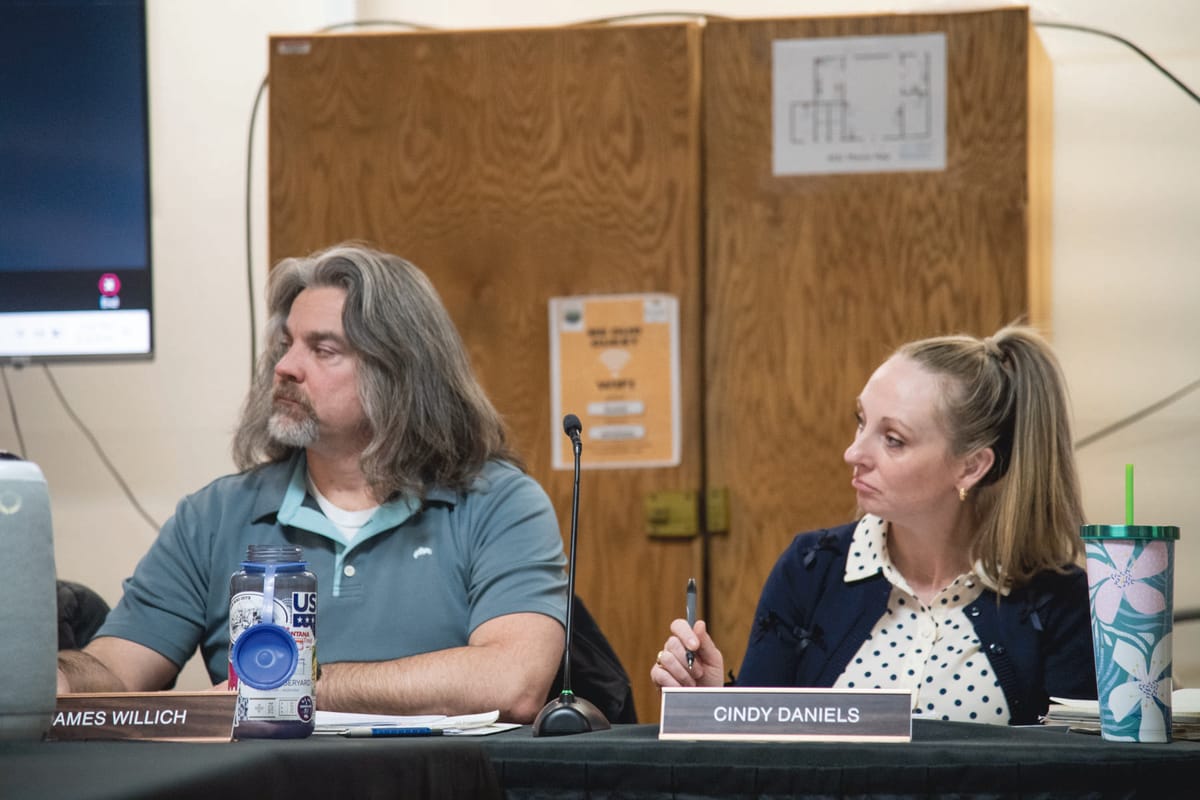
Throughout the 2025 campaign for Livingston City Commissioner, candidates, including all three victors (Cindy Daniels, Jessica Wilcox and Kemp O’Neill), spoke at length with constituents on a longstanding issue sweeping across generations of residents for over 50 years—constructing a grade-separated railway crossing to the northside, addressing safety concerns and accessibility with increasing importance as the city continues growing with potential large-scale residential development always on the horizon.
At the regular scheduled commission meeting on Tuesday, February 3rd, the issue was again raised following a presentation by City Manager Grant Gager upon request by the new commission at a work session held in mid-January, where each candidate shared their respective priorities for the upcoming year. In the aggregate, commissioners identified the railway crossing as a foremost pressing need in the community.
“This has been one of the most discussed topics since I was appointed a little over three years ago. And it is one [topic] that has been around in the City of Livingston much longer than that. So, I welcome the opportunity for discussion and direction from here forward,” Gager announced during opening remarks.
The previous commission, according to Gager, technically initiated this process during the third quarter of 2025 at two consecutive meetings in August and September by conscripting city staff to launch a survey designed for garnering feedback from the community—intended to inform a complex, time-consuming process spanning multiple years with potential financial implications for property owners.
“Earlier in my career, I had the opportunity to work on a number of these projects in all phases, from alternatives analysis, through design, construction and conditioning, from both the railroad and public entity side. So, I’m rather familiar with them.”
“And it is fairly safe to say that once funding and a location are identified, the entitlement, design and construction process take up to five years. These are extremely long duration projects. That’s just once funding and location are identified. And so we are not at that point, and as I think we know, there’s no identified location for a new crossing within the city,” he explained.
Gager, whose experience in public transportation includes managing projects for metropolitan railway systems in southern California and New York City, began by discussing previous attempts by City officials to secure funding for the project, including a 2008 referendum passed by the electorate to implement a temporary levy valued at $8.7 million dollars, in addition to federal funding eventually rescinded due to persistent delaying. Voters then rejected a second referendum proposed in 2021 for general obligation bonds worth $20 million, ultimately ceasing efforts to the effect of a five-year moratorium since suspended at the meeting Tuesday.
As expected, estimated project expenses, according to Gager, could range from $20 to $25 million dollars and up to $50 million dollars based on similar projects throughout the state. Federal funding, he said, is extraordinarily difficult for a community like Livingston to obtain.
Nonetheless survey results collected from 302 residents indicated general favorability for installing a new crossing. For instance, 63% of all respondents ranked the proposed grade separated crossing as their top priority, 138 of which were northside residents (218 respondents verified their address using utility account information), who differed only slightly from the general public (those who did not verify their residence, as well as self-identified county residents). Somewhat unsurprisingly, priorities varied across the city. Northside residents, for instance, and those who live in the quadrant south of the tracks and east of Yellowstone Street, expressed different priorities for improving infrastructure.
Three other civil engineering projects throughout the city were also evaluated and discussed, including railway crossings on Bennett, 5th Street and Main and B Street.
Prior to public commentary, commissioners inquired about a number of topics, including improving public outreach strategies regarding the survey, funding and budgeting (impact fee coffers, estimated property tax levees per $100,000, etc.) and reviewing previously failed plans to inform future projects.
Several residents then took to the podium to share ideas about how the city should proceed, some suggesting construction be contracted locally with emphasis on a potential cross at Northern Lights Boulevard and U.S. Highway 10—“a cost-effective option with low environmental impact” and “a much lower likelihood of obstruction of [emergency] services or traffic,” resident Max Johannsen explained.
Becky Bird, a 2025 Livingston City Commission candidate said, “I think the last thing I want to comment about is how we are talking about our city… maybe we should start referring to some of these issues as a community issues, and not a northside issues or a southside issue. So, we can assure to encourage that broad pool community range of support for decisions.”
Others expressed safety concerns for northside residents due to railway blockings and potential flooding—restricting access for emergency responders and preventing evacuation, if necessary.
Following a brief intermission, the commission deliberated on survey response rates, tax implications based on residential status (between and within the county and city), and community safety regarding fire risk and emergency evacuation—each of which were addressed in tandem by Chair Melissa Nootz and Gager.
Discussion regarding the grade separated crossing concluded with proposals for an alternatives analysis to review possible locations—evaluating feasibility, traffic/development impacts and costs—for developing a locally preferred alternative on which a referendum would be issued to voters prior to design and construction. Commissioners reached a consensus on first proceeding with identifying a viable location for the crossing—recruiting a civil engineering firm to conduct the study—and made distinct recommendations for pursuing other crossing projects in the near future with significant overlap in opinion.
For more information, please review the agenda packet and meeting recording at https://www.livingstonmontana.org/meetings.
Share this article
The link has been copied!
Your link has expired. Please request a new one.
Your link has expired. Please request a new one.
Your link has expired. Please request a new one.
Great! You've successfully signed up.
Great! You've successfully signed up.
Welcome back! You've successfully signed in.
Success! You now have access to additional content.