
New Commissioners Sworn In; Nootz Elected Chair

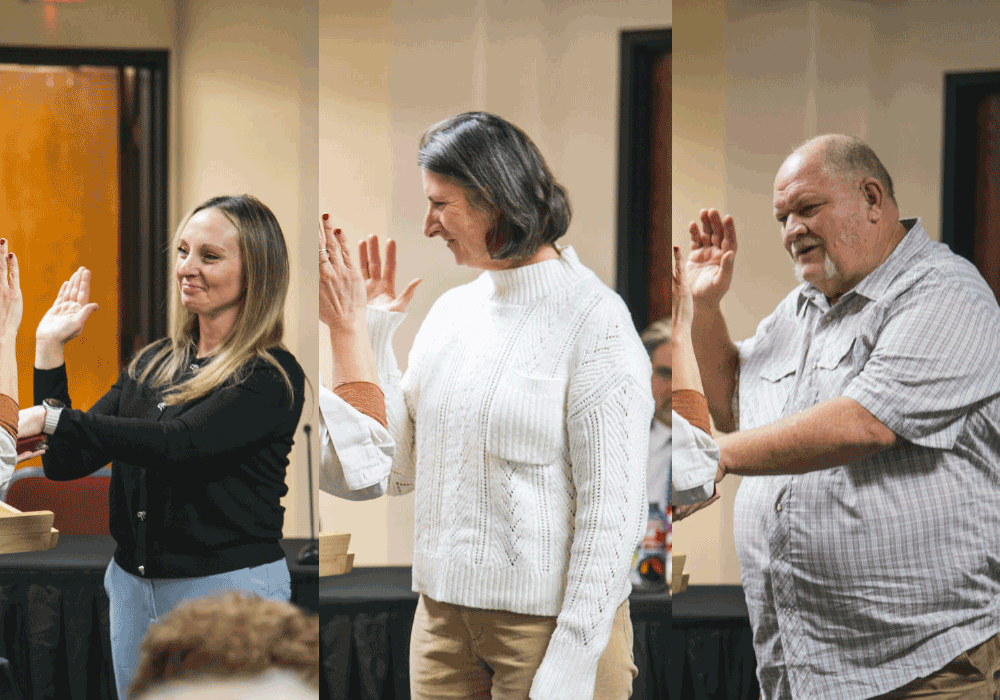
The Livingston City Commission welcomed three new members elected during the November 2025 general election at a regular meeting scheduled for January 6th, bidding a bittersweet farewell to commissioners Karrie Kahle, Torrey Lyons and Quentin Schwarz, marking the beginning of a new era in the municipal government. The transition, expected to reflect a subtle shift in the political orientation of the non-partisan legislature, unfolds as a prosperous three-year period under city manager Grant Gager, appointed November 2022, concluded with a hefty workload carried out in tandem with the now former commission. Closing statements from outgoing commissioners were issued following public commentary.
“I appreciate the community and my fellow commissioners for learning and growing with me over the past four years,” remarked Lyons, who spoke first amongst his fellow retirees.
Addressing the new commissioners, Kahle said, “…I am excited for all of you and thrilled that this administration, led by Mr. Gager, is giving you the opportunity to be sworn in in front of your family and friends,” before closing with “I thank everyone sitting up at this table and Mr. Gager and the staff for everything that I have learned from all of you over the years. This will be an experience I will always remember and certainly you will see me still but just on the other side of the table.”
“I feel so comfortable going out knowing the great shape this city is in [with Mr. Gager] and the future looks very, very bright. We are financially in a very good place. And you can’t do it without a great city staff. It’s incredible, the number of people and how dedicated they are. When you see them on the streets, tell them hi and thank you” Schwarz exclaimed before vacating his seat, together with Kahle and Lyons, for a warm sendoff just prior to the inauguration ceremony.
Cindy Daniels, Jessica Wilcox and Kemp O’Neill were then sworn in and welcomed by senior commission member Melissa Nootz, soon thereafter declared Chair following a joint motion by James Willich, concurrently nominating himself Vice. The motion was seconded by Wilcox and approved unanimously without deliberation—presumptively with respect to seniority and experience as Nootz enters the latter half of her second term due to expire in 2027. Nootz reprises her role as Chair, previously serving two consecutive years from 2022 to 2024, after a stint as Vice Chair beginning January 2024.
As clarified by Gager, the officer election process was codified in 1986 via referendum by the electorate to adopt the commissioner-manager form of government. As stipulated by Montana Annotated Code, officers are elected amongst themselves through a nomination process—sometimes, though not necessarily—preceded by a discussion. The Chair is responsible for leading bi-weekly proceedings and endorsing commission-approved documentation with no designated authority over the city manager, city staff members or any other function of government. Nonetheless commissioners maintain equal status as no single member wields greater power over their peers.
In their newly authorized decision-making capacity, the next commission approved the 2026 regular meeting schedule (the first and third Tuesday of each month, a longstanding tradition continued with exceptions on August 4th and November 3rd for National Night Out and Election Day) and appointments to various community and city advisory boards.
Nootz, responsible for appointing commissioners to each board, initiated the process by asking members to clarify their preferences according to personal interests and strengths, eventually reaching a compromise. Per request, Vice Chair Willich retained his current appointment to the City-County Health board. New commissioners Daniels, Wilcox and O’Neill were appointed to the Consolidated Land Use Board, City-County Library Board of Trustees and the Livingston Community Trust Board, respectively. Nootz, formerly seated on the Consolidated Land Use Board, will now serve on the Urban Renewal Agency. Whether commissioners serve in an advisory or voting capacity varies between boards.
The meeting effectively concluded with a growth policy progress update, presented by Gager to the commission and public as he sought feedback to inform future initiatives across nine elements—economy, housing, land use, local services, public facilities, population and community character, natural resources, and transportation. The policy, a non-regulatory document adopted in 2021 to guide local growth, is “structured with a series of goals supported by one or more objectives achieved through various strategies,” according to Gager—21 goals, 74 objectives and 219 strategies to be exact.
Gager shared that to date, 73 (or 33%) of the 219 total strategies had been implemented—a 12% increase from 46 total strategies, 27 of which were implemented since just October 7th, 2025. This remarkable period of growth includes adoption of the parks master plan and zoning map, zoning code ordinance updates, floodplain regulation updates and subdivision regulation ordinances, among others. Currently 39% of strategies are in progress whereas an additional 13% have reached the stage of policy development. Only 15% of the total strategies outlined in the document have not been initiated.
Future initiatives, according to Gager, include but are not limited to stormwater management evaluation efforts, emergency response planning, partnership with county growth plan process, wayfinding and economic development, the annexation policy and northside transportation plan—the long-awaited and highly anticipated railway crossing slated for development in coming years, an issue on which many of the newly elected commissioners recently campaigned.
The growth policy itself is due for a five-year review as required by state law, a complex and potentially lengthy process involving external consultation for which Gager has allocated up to $50,000 from the City’s budget ($25,000 appropriated for the current fiscal year) with intentions to begin the process summer 2026. The new commission was invited to provide commentary regarding Gager’s presentation.
Willich motioned to schedule a separate work session, presumably within the next one to two weeks well in advance of the new budgeting cycle, to discuss each commissioner’s priorities for the upcoming year—ultimately to arrive at a set of shared goals the commission may pursue collectively. Work sessions as such are strictly conversational. The motion was seconded by O’Neill and will eventually be noticed for open attendance by the public.